


EUDR Update: What European Buyers Need To Know-- And How Senyangwood Can Help
Jul 07, 2026
Leave a message
On May 4th 2026, the European Commission published a new set of measures to simplify the EU Deforestation Regulation (EUDR). With the mandatory enforcement date of December 30th 2026 approaching fast, European buyers need to prepare their supply chains now.

This article gives you a clear overview of the latest changes and practical steps forward.
1. What's New with EUDR?
EUDR requires all relevant products- covering seven commodities (wood, cattle, cocoa, coffee, oil palm, rubber, soy) and their derivatives- to provide proof of "deforestation-free" production since December 31st 2020, along with a Due Diligence Statement (DDS) submitted through the EU TRACES system.
Key updates from the May 2026 package:
- Implementation timeline confirmed:
Large & medium-sized operators: 30 December 2026 (no further delay)
Micro & small enterprises: 30 June 2027
- Compliance cost reduced significantly:
The European Commission estimates that the simplified rules will cut annual compliance costs by about 75% compared to the original proposal.
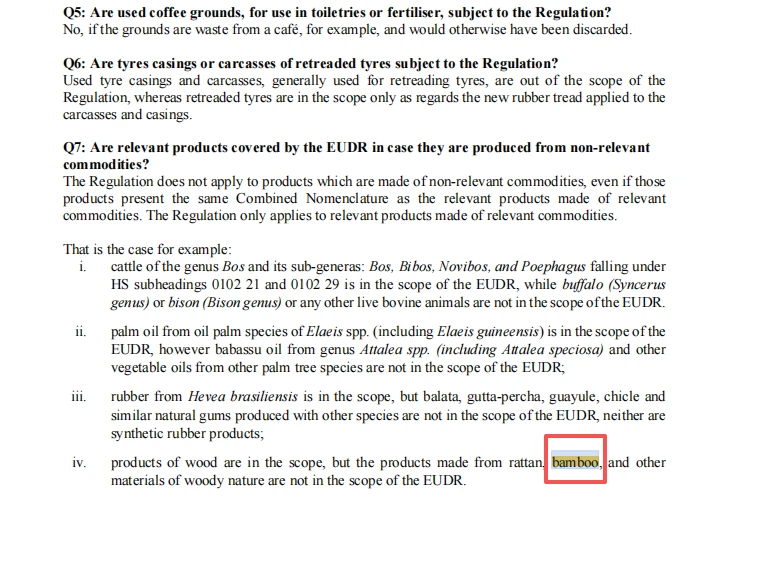
- Bamboo explicitly exempted:
The draft revision published on 4 May 2026 clearly excludes bamboo from the scope of EUDR.
No plot-level geolocation data is required. No due diligence statement is required for bamboo products.
- Product scope adjustments:
Newly added: instant coffee, certain palm oil derivatives (e.g., soap containing palm oil)
Exempted: samples, disposable packaging, second-hand goods, waste products, etc.
2. What Should European Buyers Do Now?

A. Differentiate between wood products and bamboo products
| Product Type | Compliance Requirement | Cost Impact |
| Wood products (birch sticks, cutlery, skewr, toothpick etc.) | Geolocation data, legal harvest proof, DDS submission required | Additional traceability cost reflected in pricing |
| Bamboo products (bamboo cutlery, skewers, toothpick, chopsticks, etc.) | Exempt – no traceability required | No extra compliance cost |
B. Prioritise bamboo options where feasible
- Under the current framework, bamboo material offers the simplest and most cost-effective compliance path.
- Bamboo is classified as a "non-wood forest product" and is therefore outside the regulation's scope.
C. Engage with your suppliers early
- For wood products, ask your supplier for geolocation data, legal harvest certificates, and production batch records.
- Confirm that your supplier's traceability system can support EUDR information system requirements.
3. How Senyangwood Can Support You
With 37 years of experience in disposable bamboo and wood products, Senyangwood offers:
✅ Bamboo product solutions – no compliance burden
Full range: bamboo cutlery, bamboo skewers, bamboo toothpick, bamboo chopsticks, bamboo cotton swab and more
Bamboo is not subject to EUDR - no traceability cost, no DDS filing
Same quality as wood-- simpler paperwork


✅ Wood product compliance support
We can provide geolocation data and legal sourcing documents for wood-based cutlery, wood skewer, wood toothpick, wood chopsticks, wood cone, cup or boat etc.
We assist in preparing data for your Due Diligence Statement submission
✅ One-stop customization service
Hot stamped logo print, Laser engraving, custom sizes, tailored packaging
37 years of expertise, exported to 100+ countries
4. Final Thoughts
EUDR is both a challenge and an opportunity to build a greener supply chain.
For European buyers, bamboo products stand out as the most cost-effective and compliant choice, thanks to their regulatory exemption.
Senyangwood is ready to work with you- providing compliant, sustainable, and reliable bamboo and wood solutions.
For any EUDR-related questions, feel free to contact us.

Send Inquiry